Russia's president says last week's naval incident off Crimea was co-ordinated to assess Moscow's response.
from BBC News - World https://ift.tt/3y8gydM
Wednesday, 30 June 2021

Paris threatens e-scooter ban after woman's death
Electric scooter providers in the French capital could lose licences if safety issues are not tackled.
from BBC News - World https://ift.tt/3jpuXOx
from BBC News - World https://ift.tt/3jpuXOx
Canada weather: Canadians enduring 'unbearable' heatwave
Dozens of people have died in Canada as temperatures reach a record-breaking 49.6C (121F).
from BBC News - World https://ift.tt/2Tl883S
from BBC News - World https://ift.tt/2Tl883S
New on Sports Illustrated: Is This As Good As It Gets for DeAndre Ayton? Not Likely
DeAndre Ayton's star turn has been impressive—but it's also forcing us to reconsider his ceiling.
View the
original article to see embedded media.
Welcome to the Morning Shootaround, where every weekday you’ll get a fresh, topical column from one of SI.com’s NBA writers: Howard Beck on Mondays, Chris Mannix on Tuesdays, Michael Pina on Wednesdays, Chris Herring on Thursdays and Rohan Nadkarni on Fridays.
About a week before Christmas in 2019, Deandre Ayton was late to a game at Staples Center against the Clippers. It was his first in nearly two months, thanks to a 25-game suspension handed down by the NBA after Ayton violated its drug policy by testing positive for a banned diuretic. In the aftermath, Suns general manager James Jones issued the type of self-condemning statement that teams rarely make toward one of their own building blocks, writing: “This does not uphold the standards and principles we have set for the team.”
Ayton was apologetic and sincere addressing his punishment and return on that December night. At the same time, he brushed off his tardiness as incidental, later blaming it on “L.A. traffic.” The Suns struggled during their No. 1 pick’s absence, but Aron Baynes, their 32-year-old backup center, played well enough (when he was healthy) to create something of an awkward dynamic upon Ayton’s return, given his presumed importance in the short- and long-term as a starter.
Ayton sprained his ankle against the Clippers. Then, when he made his second comeback six games later, he came off the bench in five of the next eight. The three he started were at power forward, next to Baynes. Ayton was out of shape, rushing shots, inconsistently diving hard to the rim. Through it all, Monty Williams—who coached Anthony Davis during his first three seasons—wasn’t fazed. “We’re going to develop him and bring him along the right way,” Williams said at the time.
Fast forward to last week, minutes after the Valley-Oop instantly cemented itself as an iconic moment in franchise history. Ayton was bouncing through questions during a celebratory postgame press conference when a reporter asked how he’s come to realize the difference between showing up to collect a paycheck and showing up to earn it. “There was times where I wouldn’t even come in on days off,” he said, before praising the effect his head coach has had.
But some bumps still carried into this year. “To see his growth, man, I get goose bumps, seriously,” Chris Paul recently said. “We done had some heated conversations this season, especially earlier in the season, but man, I genuinely love him.”
There have been nights during this postseason when all of that struggle, the growing pains and hard lessons feel like they were endured in a previous lifetime. The player Phoenix hoped and prayed it was getting when it chose Ayton ahead of Luka Dončić and Trae Young has arrived ahead of schedule, granted in a much different form than anyone anticipated.
Far from the capricious X-factor so many expected to see heading into the playoffs, Ayton has instead enjoyed the most consistent and significant breakout run of any young player. Young has no doubt starred, but he also started last year’s All-Star game and has long been guaranteed to receive a max contract extension as soon as he became eligible. Ayton was more of a mystery box. So far, he’s been the absolute best version of exactly what Phoenix needs.
When recently asked about the seemingly overnight transformation from a solid but unreliable two-way anchor who might not hold up against the rigors big men must deal with in playoff games that are largely decided on the perimeter, Ayton recently said “Honestly, the world having me as a question mark in the playoffs, that got to me a little bit. And I’m going to change that.”
Change it he has, in interesting ways. Ayton is making 70% of his 10.7 field goal attempts per game, and 79% at the rim, where 7.1 of those tries come from. Heading into this postseason (reminder: it’s Ayton’s first!), the highest field goal percentage any player has ever had taking at least 150 shots was James Worthy’s 62.2% in 1985. The gap between Ayton’s field goal percentage and Worthy’s is the same as Worthy and 77th-ranked Kiki Vandeweghe, who shot 54.4% in 1983.
As a roll man, we haven’t really seen anything that rivals Ayton’s volume or efficiency, a fact supported by data and the millions of eyes that are watching him regularly sky over the box to catch lobs that’d otherwise reach the third row, or muscle his way through traffic and still finish over a rotating backline defender.
According to Synergy Sports, 30.2% of Ayton’s possessions in this postseason are finished as a roll man, which is up 11% from the regular season. The increase makes sense when you consider that in Synergy’s entire database—which goes back to the 2005 playoffs—the only player (on a minimum of 50 possessions) who has ever been more efficient after setting a screen is 30-year-old Al Horford. All the buckets Ayton has scored in these situations don’t even account for the wide open threes he produces by rolling his massive frame toward the basket. (Cam Johnson and Mikal Bridges say thank you.)
All the fat has been burned out of Ayton’s attack. By focusing on less glamorous sides of the game (putbacks, rim runs, contested rebounds, sturdy pick-and-roll defense, screens, etc.) he has excelled without stretching himself in ways that might blunt his impact.
Out of every Suns player who’s logged at least 100 playoff minutes, he ranks sixth in usage rate, behind Dario Šarić and Torrey Craig. This less-is-more coming out party creates a few separate ways to view Ayton’s run. One is that he couldn’t be in a more ideal spot, surrounded by elite three-point shooters, ball movers, a point god and another top-tier scorer who attracts a massive amount of attention. Almost 90% of all Ayton’s shots have come in the paint, 83% have been assisted (up from 72% during the regular season) and despite averaging five more minutes in the playoffs, his post-ups have been cut nearly in half.
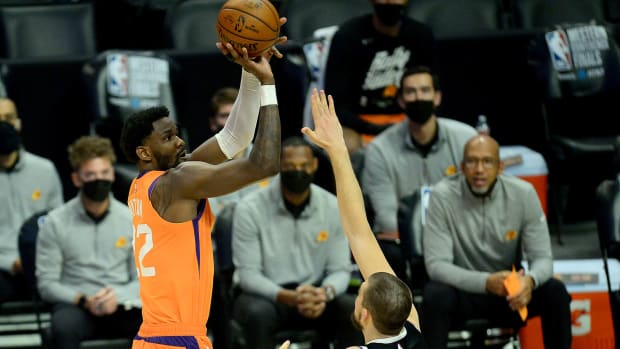
All this has served him and the Suns well. As has a quality of competition that hasn’t been, shall we say, intact. If you’re an Ayton skeptic, you’ll quickly point to the fact that he has not been forced to match up against a healthy Anthony Davis, the lethal Jamal Murray–Nikola Jokić pick-and-roll or small-ball lineups that have Kawhi Leonard in them. This is obviously unfair to Ayton, who has no say over his opponent’s health. All he did in the second round was neutralize Jokić one-on-one better than any big man has, while dominating his space against three teams that haven’t been able to exploit his shortcomings.
It hasn’t all been smooth, though. In Game 5 of the conference finals, with Ivica Zubac out of the lineup, some of the issues tied to what Ayton can’t or won’t do could not be ignored. The Clippers defended him with Nicolas Batum or Marcus Morris and stayed small, either switching pick-and-rolls that involved Paul or Devin Booker or forcing the Suns to attack a smoke-and-mirrors zone.
Ty Lue’s bet was that Ayton couldn’t pound his guards and wings in the post; every time the Clippers fronted him until he gave up and drifted out of the paint, it paid off. (On one early paint catch off a roll, Ayton tried to seal Terance Mann but was moved off his spot before a quick jump hook fell short. The Suns made little effort to feed him from that point on.)
That was only step one, though. L.A. further offset Ayton’s force by crashing the glass as a group whenever he seemingly held inside position on his man. Ayton only came up with three offensive rebounds (down from a whopping nine in Game 4).
On the defensive end, the Clippers treated Ayton (who finished -22) exactly how they did Rudy Gobert in Game 6 of the previous round, putting whoever he was guarding in the strongside corner and then driving that half towards the rim. The results would either be a decent look around the basket or, if Ayton helped—which he just about never did, unlike Gobert—an open-corner three.
Afterward, Lue was asked why he went with Batum over Mann (who killed Gobert from the corner in that Game 6). “I just wanted to try to get Ayton out of the paint a little bit more. I wanted to see who he was going to guard, with Marcus and Nico in there at the four and the five. So it worked out in our advantage. I just think being able to spread him out.… It was great for us because now we were able to move him around a little bit more and we were able to get open shots.”
Outside that uncomfortable stretch, Ayton’s defense has been stellar, enough for his coach to make some borderline outlandish comparisons earlier in the series. “DA has defensive gifts that not many bigs have. The guy that he reminded me of is like two guys, LaMarcus [Aldridge] and [Kevin] Garnett in pick-and-roll coverages, the way that they talk and their athleticism to switch and cover for the guy on the ball.”
You can’t teach size. You can’t teach strength. You can’t teach the coordination, skill and touch Ayton has as a 22-year-old. And that brings us to yet another way to process Ayton’s first playoffs: with a splash of optimism! Looking back on the 2021 playoffs in five years, the most telling part of his revelatory run might just in fact be everything he isn’t doing.
This is not a call for Ayton to step outside his lane anytime soon, but using this postseason as a baseline, one that should infuse him with plenty of confidence going forward, it’s hard not to rethink Ayton’s ceiling.
Consider, as an example, his outside shot. Again, this isn’t a call for Ayton to extricate himself from the paint. But there should be a day when leaving him open at 18 feet isn’t survivable. A threat that can open lanes for everybody else. All the better if/when he develops a reliable three-point shot.
Ayton’s rolls have been devastating, but there will soon be a day when Paul isn’t around to unlock them. When defenses sink in to take away those point-blank opportunities, Ayton can pop out to the midrange for open looks that he’s already comfortable taking and making.
The next element worth a look is his post game, which has disappeared—with good reason—in these playoffs. Ayton’s post-ups are down from 27.5% of his used possessions during the regular season to 11.6% right now, where he’s scoring a paltry 0.54 points per possession.
Back-to-the-basket bully ball doesn’t need to be the primary way Ayton attacks similarly sized centers. But if he can develop a more patient game on the block, one that gift wraps his freakish agility and raw power into a package that can draw double teams, instead of settling for the quick face-up jumpers he’s fallen in love with, Ayton can be even more of a matchup nightmare than he already is. He can initiate offense more often than he finishes it while punishing teams that go small against him—as the Clippers did on Monday.
There won’t be as much urgency for Ayton to develop if the Suns win the title. But if they come up short, Paul’s pending exit shines light on Ayton’s inevitable need to be more self-sufficient. (“I think he was the best thing that happened to my career,” Ayton recently said about his point guard.)
None of this is aimed to delegitimize an incredible playoff debut from an absurdly talented prospect who’s been willing to sacrifice for the good of his team. Ayton was humbled early in his career. And while he likely wouldn’t choose that road again, the adversity served a purpose: Instead of producing like a typical first pick might, he’s embraced and shined in a much simpler role, free of pressure and complexity.
What that says about who he can be going forward is very much up in the air. If you’re bullish, Ayton is just scratching the surface of a skill set that will eventually make him an unstoppable weapon. If not, all his weaknesses will be particularly damaging in the future, when Phoenix’s roster is less ideal than the magical one they’ve constructed in his third season.
More NBA Playoffs Coverage:
• Playoff P to the Rescue for the Clippers
• Beck: The Irony of the Mavericks' Hires
• Pina: The NBA Playoffs All-Money Team
• How It Feels to Watch the Team You Built Thrive Without You
New on Sports Illustrated: Mailbag: How Many Super Bowls Would Aaron Rodgers and Tom Brady Have on Each Other's Teams
Which legendary quarterback would have had the better career if they'd been drafted by their counterpart's team? Plus, the Jaguars' odds, Trey Lance's ceiling, the best concerts and hot wings, and more.
We’re heading into what promises to be a lovely Fourth of July weekend here in the Northeast. Albert Breer is on vacation and I’ve decided to take some time away from ordering nonalcoholic craft beer and perfecting my Old Bay potato salad recipe to answer some questions from his stuffed mailbag.
Let’s boogie …
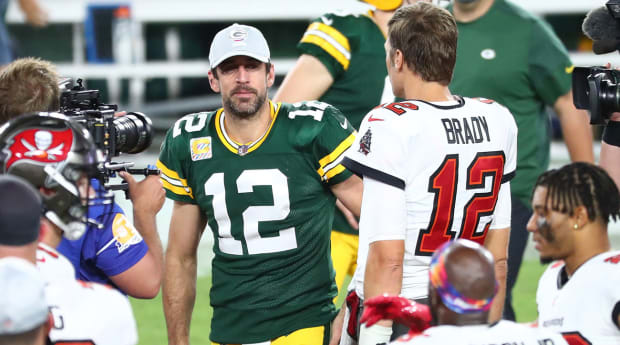
From Myles Powicki (@MylesPowicki): How many Super Bowls would Tom Brady have on all of Aaron Rodgers’s teams and vice versa?
Hey Myles, thanks for submitting this very interesting question. I talked to former Giants safety Antrel Rolle not long ago, and he was talking about how their three-safety look puzzled both Brady and Rodgers alike during their 2011 run to the Super Bowl. My point here is that there were some brief innovations in NFL history that may have stymied both of them equally. That said, I think that Rodgers would have won three, maybe four, of the seven Super Bowls Brady won over that same window. I think Brady would have won zero of the Super Bowls that Rodgers won on the Packers, and here’s why …
New England in the early 2000s was the closest thing we’ve had to a true, nonpolitical meritocracy in the NFL. I don’t know if Brady, had he been
drafted in the seventh round by the Packers, would have had the chance to rise through the organization like he did in New England, thus cementing himself as a journeyman backup. He was obviously good enough to become the greatest player in NFL history, but I think a lot of his rise had to do with a willingness from the Patriots’ coaching staff to buck traditional thinking and pour their resources behind someone like Brady, along with Brady’s ability to see that working the way he did was going to be rewarded. A lot of teams preach hard work, but few of them, I think, would have recognized and valued the little things that Brady did, like obsessively study opponent quarterbacks in order to give the Patriots the best scout team looks in practice. So, I think Rodgers would have done Rodgers things in New England on very good rosters with a great offensive coordinator. I think Brady would have supplanted Brett Favre in an offense that didn’t necessarily bend to his skill set, and he’d have had a difficult time ever achieving the kind of liftoff he had with the Patriots.There are so many aspects of the Brady mythos that are situationally dependent. For example, would he have met his controversial super-trainer, Alex Guerrero, if he had not been in the locker room with Willie McGinest back in 2006 when the Patriots’ star defensive player started bringing Guerrero around? What would the back end of his career after his 2008 ACL tear have looked like otherwise? Would Brady have been able to succeed on a Packers roster that notoriously shunned the acquisition of free agents, unlike a Patriots roster that, over the years, acquired the likes of Randy Moss and also built one of the NFL’s real, top-to-bottom, middle-class rosters full of talented veterans hanging in New England’s orbit at a discounted price in order to win a championship?
Would he have won as frequently with Mike Sherman or Mike McCarthy, who were notoriously stubborn when it came to their systems, instead of Bill Belichick and Josh McDaniels, who changed the way teams custom game planned for opponents (a large part of which, we admit, Brady also had a significant hand in)? Would he have won as many games without being in an offense for the better part of 20 years (one he carried with him to Tampa Bay, essentially convincing the Buccaneers to reroute at the end of the 2020 season to run)? Would Brady have gotten famous and expensive enough to take a notoriously lower contract to aid in Green Bay’s roster construction over a long period of time?
I think from a talent perspective, most of us can agree that the raw, God-given tools Rodgers has to work with are slightly better than the ones Brady was born with. Rodgers is a tremendous competitor, though Brady may have redefined the meaning of competitiveness over his tenure in the NFL. Is that enough on its own to have transformed him into the player he is now without all of the other mitigating circumstances? Have there been other Bradys over the course of NFL history who had the will and the work ethic to reach that level, but were ditched by coaches scared of the optics, thus shooting down promising careers before they started?
Brady needed to be paired with Belichick, the guy who had the fortitude to fire Bernie Kosar in Cleveland and, later, the guy who was comfortable moving on from Drew Bledsoe, in order to set a lot of this in motion. Rodgers, meanwhile, could have been put on a lot of rosters and won Super Bowls simply by virtue of being an exceptionally talented and driven player. And, because he was a first-round pick, he inevitably would’ve gotten more chances.
From Stagger McTipsy (@StaggerMcTipsy0): What is the best concert you’ve ever attended?
Thanks for the question, Stagger. Those who have read some of my work can probably guess which direction this is headed. I would say my first “real” concert, which was the Allman Brothers and Moe. at Montage Mountain in Moosic, Pa., will always hold a special significance in my heart. I have seen Moe. about a half dozen times now and have always enjoyed the atmosphere at their shows. A close second would be Joe Russo’s Almost Dead, which I caught at the Brooklyn Bowl. They had John Mayer, who currently tours with Dead and Company, sit in on Althea, and it was really special. I was always bummed I didn’t get to see The Grateful Dead in their prime (mid-to-late 1970s), but this felt about as close as I could come. Young, talented musicians really capturing the spirit of the thing.
Other close seconds and thirds:
• Rage Against the Machine, Rock the Bells 2007
• Tom Petty and the Heartbreakers at the Fillmore in Philadelphia
• Paul McCartney at MetLife Stadium, 2016
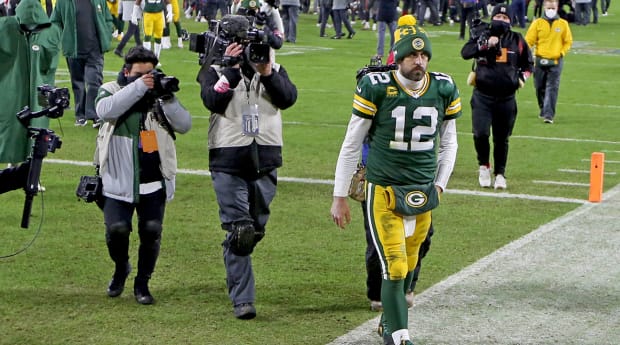
From Craig Ginsberg (@CraigAdamG): How do you see the Green Bay–Rodgers saga ending?
Hey Craig, thanks for the question and happy Fourth. It’s interesting; I’ve talked to people in close proximity to the situation who aren’t sure how it’s going to end. Here’s ultimately what I think will happen, based on the current state of play and my gut instinct. Rodgers, one of the most competitive people on planet earth, needs to do a much better job of convincing the Packers that he’s willing to drop everything, take a massive pay cut and sit out while Jordan Love takes a crack at this very amenable offense than he’s currently doing. I don’t think he’ll be traded. I think he’s made the strongest point that he could possibly make, and at this moment, the ball is in his court to dig in his heels and find another layer of discontent.
If I were Rodgers, I would be looking out at the teams that were allegedly on my leaked trade destinations list. The 49ers have Trey Lance, so they’re out. Then you’re looking at the Broncos and the Raiders, neither of which have an offensive identity or established weapon set. Green Bay has the offense. The one every quarterback is calling their agent to try and find a way to run. They have the coordinator whom Rodgers respects. They have a great running game and a good defense. They’ve won 13 games each of the last two years and the division is still soft. Long-term marriages are complicated, but I would speculate that he’s smart enough to realize that his best shot at winning a Super Bowl is on this team, right here, right now. I would expect that at some point early in training camp, we’ll have the frantic, CNN-style helicopter landing, and Rodgers will come out and gracefully voice his displeasure while somehow managing to scoop the upper hand on management in the court of public opinion. There will be a new contract. Then a new viewpoint on the Love replacement timeline. And, of course, a relieved Brian Gutekunst and Matt LaFleur, finally attempting to exhale.
From Tony C (@Bucz109): I have never heard of Jermyn, Pennsylvania and only live 2.5 hours away. Are the hot wings worth making the drive out there?
Hey Tony, the short answer is yes. Jermyn is home to the Windsor Inn, which advertises itself as having “the world’s second-best hot wings.” I might agree with that, as the only wings I’ve ever had that are better are at Bar-Bill in Buffalo. I made the trip home this past weekend (I was raised in Clarks Summit, Pa.) and picked up 120 wings from the Windsor to share with my friends. It was delightful. One of the rare times where something you build up in your mind during your childhood secures its excellence 17 years later.
From Michael Cameron Vegh (@MichaelCVegh): The Jaguars currently sit at 8-1 odds to win the AFC South. What would it take from their squad to win the AFC in Trevor Lawrence and Urban Meyer's first run in a seemingly winnable division?
Hey Michael, thanks for the question. I think it would take quite a lot for the Jaguars to win the division here. This is the Colts’ division to lose in 2021, and I don’t think it’s necessarily close. Carson Wentz will be back to looking like vintage Wentz in an offense that gives him reasonable reads and doesn’t force him to play hero ball on every down. The Titans will finish second and Jacksonville should hope that they beat the pulp out of the Texans twice this year and finish Meyer’s first campaign with enough steam to legitimize the massive decision to hire a collegiate coach in the first place. The Jaguars needed help stopping the run, but went with a running back for their second first-round pick. They’re in a division with Derrick Henry and Jonathan Taylor, which, regardless of how well Joe Cullen does in his first year as DC, is going to be a gargantuan task to stop.
I’ll also be watching Lawrence to see how quickly the offense goes from clunky to seamless. Brian Schottenheimer and Darrell Bevell have a lot of work ahead of them, and their schematic experiences tend to lean more pro style. Bevell did a good job protecting Russell Wilson early in his career, as did Schottenheimer with Mark Sanchez in 2009 and ’10, handing the offense over in chunks and increasing the responsibilities over time. Lawrence, though, will be expected to move at an expedited pace with a less-talented surrounding class. I’m not sure that’s possible.
From Connor Grossman (@connorgrossman): Who's the starting quarterback on the next 49ers team to win the Super Bowl? What kind of acai bowl does he like?
Connor! Miss you, buddy. It’s not the same here at SI now that people don’t mistakenly send me your emails. Trey Lance will win a Super Bowl with the 49ers. I have very little doubt about this. I think it will happen soon, quite possibly next year. Teams already have a difficult enough time stopping Kyle Shanahan’s offense. It has evolved to the point where they have answers for almost anything a defense is going to throw at them and their running game, buoyed by offensive coordinator Mike McDaniel, is the most maximized and well-understood system in the NFL. And now that everyone has spent an offseason figuring out how to crack the code, Lance can become a power rusher and destroy the math defensive coordinators have been working with for the last five years. If you are in a dynasty fantasy league and do not pick Lance, I hope you enjoy finishing out of the money each and every year.
Part II: I don’t know if Lance likes acai, or what kind, but here is my mainstay of late, courtesy of the Playa Bowls near my house: Coconut base, vegan granola, flax oil, almond butter and bananas.
From Neal (@CapitolTitans): I don’t get the Zach Wilson thing. It seems like no one besides the Jets would’ve taken him at No. 2, they just locked on and wanted him for some reason. Am I wrong about this?
Hey Neal, I would say you are kind of wrong about this (the Eagles, for one, probably would have taken him), but here’s a fun way to think about the situation: Imagine being Robert Saleh, a first-time head coach, after waiting three cycles to land a gig. The first thing your team does is pick a quarterback. You’re a defensive-minded head coach, so a lot of the legwork is going to fall on the general manager and the offensive coordinator. The guy picking behind you was Kyle Shanahan, your former boss, who jetted up the draft board once it became obvious that you were taking Zach Wilson to select the guy after you. Would you be worried in the least? Would there be any hesitation?
I’m not saying any of this is true for Saleh, but it underscores the faith he must have in Joe Douglas and the faith the Jets have in Douglas to have traded away Sam Darnold in the first place. I think Wilson will succeed, but that’s because Saleh was savvy enough to lure Mike LaFleur and run-game coordinator John Benton away from San Francisco. That was huge. I took a trip to Jets OTAs last week at the end of minicamp and was impressed by a few high-difficulty throws Wilson made against a heavy pass rush. There were a lot of batted passes and a few notable throws behind wide receivers he has little to no relationship with, but there were also some touch passes he made against surging defensive players that resulted in big gains during a (somewhat) live situation. Those impressed me.
Thanks everyone for the questions! Jenny Vrentas will take over the mailbag next week, if you want to send her any questions now.
More From Conor Orr:
• 10 NFL Players Who Could Make Their First Pro Bowl in 2021
• Six Losing Teams in 2020 That Will Make the Playoffs in 2021
• Wade Davis: 'Revolutionary' Michael Sam, Others Paved Way for Carl Nassib
Yemeni model facing unfair trial by rebel authorities - rights group
Intisar al-Hammadi, who denies the charge, was detained by the rebel Houthi movement in February.
from BBC News - World https://ift.tt/3xcvBTy
from BBC News - World https://ift.tt/3xcvBTy
Covid-19: Huge crowds seek vaccine as Indonesia cases soar
Thousands of people surround an Indonesian vaccine centre as the country faces a severe outbreak.
from BBC News - World https://ift.tt/3AdVfta
from BBC News - World https://ift.tt/3AdVfta
Subscribe to:
Posts (Atom)